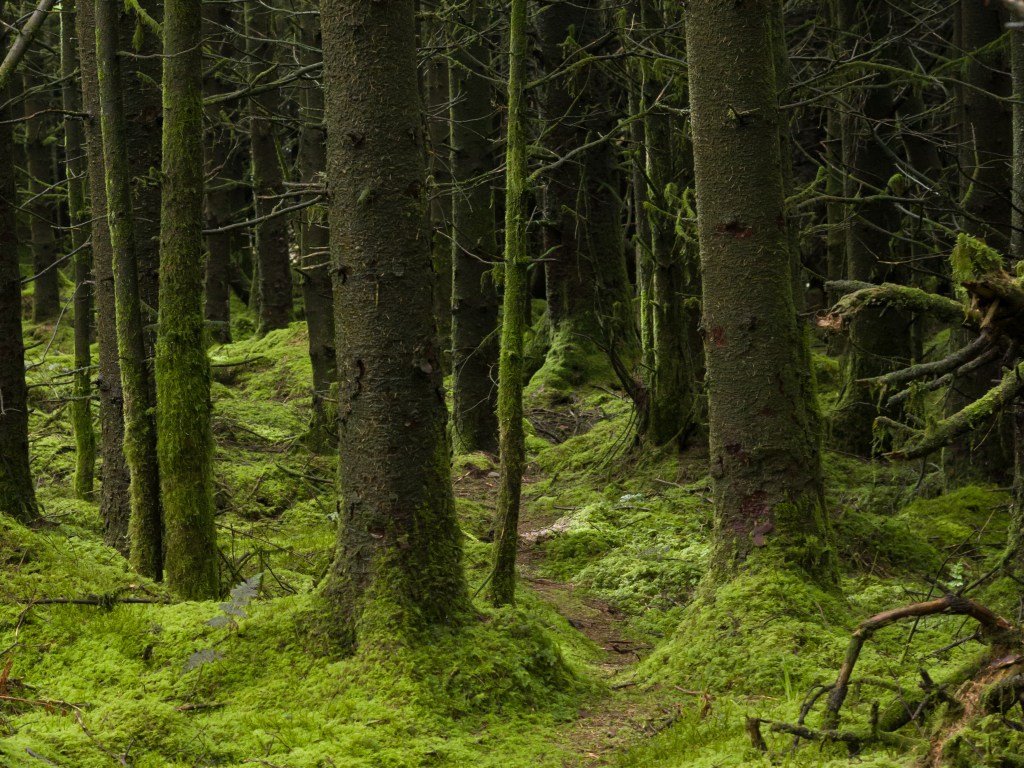
Early one morning, on a recent visit to Ireland, I took a walk in the forested hills. It was an hour or so after dawn but the ground still felt like it was holding the night. Off to the side of the trail I noticed a narrow opening. Not a path in any formal sense. No edges, no clearing, nothing marked. Easy to walk past without noticing. It took a second look to see that it continued, meandering between the trees.
I stood there for a while trying to read it. It didn’t run straight. It slipped around trunks, dipped slightly, disappeared, then reappeared a few yards on. There was no vantage point from which its direction became clear. Whatever used it wasn’t interested in showing where it was going. Only in getting there.
It raised a simple question: how does something like this come into being?
It was certainly not through design or a single pass. A path like that forms because something returns. Judging by the tracks in the area, it was probably sika deer. Again and again, the same line is taken. Small pressure, repeated over time, leaves a trace. The ground yields just enough. Moss parts slightly. Eventually it is there, though only barely.
Seeing the deer path brought to mind the habits of attention that develop over time. What is visited repeatedly becomes structure. The path was not planned that way, but repetition settled it in the ground. The same can be true of a contemplative or spiritual practice. It returns to the same places, the same questions, the same acts of noticing, often enough that a pattern begins to emerge.
Over time, that familiarity makes the next step easier. The line is already there. Like the track in the moss, it remains easy to miss from a distance, but unmistakable underfoot. It exists because the same route was taken often enough for a path to form.
 Notes from the Edge of the Forest